
Legendary Blades: The Most Fascinating Swords in Mythology and Literature
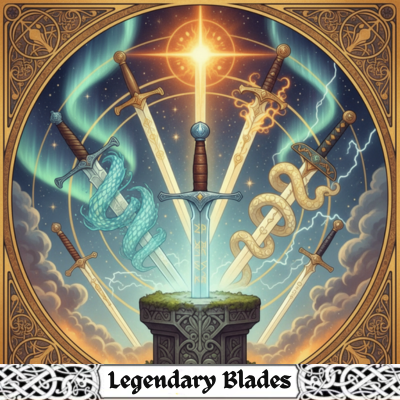

Swords have never been simple weapons. Across history and mythology, they are objects of meaning, identity, and power. A sword can crown a king, test a hero, seal an oath, or decide the fate of an entire world. Unlike other weapons, the sword stays close to its bearer, demanding skill, discipline, and responsibility.
From ancient myths to modern fantasy, legendary swords continue to capture our imagination. They are named, forged with care, broken and reforged, blessed or cursed. Each blade tells a story that goes far beyond steel. These stories reveal how cultures understood power, justice, heroism, and destiny.
What Defines a Legendary Sword
Although legendary swords come from many cultures, they share several key characteristics that elevate them above ordinary weapons.
- A unique origin: forged by a master smith, discovered in a sacred place, or gifted by divine beings.
- A test of worthiness: the blade can only be wielded by the rightful hero or ruler.
- A symbolic role: the sword represents authority, justice, destiny, or moral duty.
- A decisive moment: drawing, reforging, or using the sword changes the course of history.
These elements transform a sword into a narrative force. The blade does not simply win battles. It defines who the hero is and what they stand for.
Swords as Proof of Legitimate Rule
In many traditions, swords serve as symbols of rightful authority. Possessing the blade is not about conquest but recognition. The sword declares who should lead.
Excalibur and the Right to Rule
Excalibur remains the most famous sword of kingship in European mythology. In some versions of the Arthurian legend, Arthur draws a sword from stone, proving his destiny. In others, he receives Excalibur from the Lady of the Lake, marking divine approval of his reign.
In both cases, Excalibur represents more than strength. It symbolizes lawful rule, moral leadership, and responsibility toward the realm. The sword reinforces the idea that power must be justified by virtue, not seized by force.
Kusanagi and Imperial Authority in Japan
The Kusanagi no Tsurugi, also known as the Grass Cutting Sword, plays a similar role in Japanese tradition. According to myth, the storm god Susanoo discovered the sword in the body of a great serpent and offered it to the sun goddess Amaterasu.
Kusanagi later became one of the three Imperial Regalia of Japan. Alongside the mirror and the jewel, it symbolizes the divine legitimacy of the emperor. The sword is rarely seen, but its meaning is profound. It represents continuity, sacred authority, and the bond between ruler and tradition.
Blades Forged for Mythic Trials
Many legendary swords exist to face threats beyond the ordinary world. Dragons, giants, demons, and monsters require weapons that carry more than physical strength.
Gram, the Dragon Slayer of Norse Legend
In Norse mythology, the sword Gram is associated with the hero Sigurd. Its story involves fate, divine intervention, and master craftsmanship. In some versions, the god Odin drives the sword into a tree, and only the destined hero can remove it.
When Gram is later broken and reforged by the dwarf smith Regin, it becomes a symbol of renewal. Sigurd uses the blade to kill the dragon Fafnir, an act that represents the triumph of order over chaos and courage over fear.
Beowulf and the Limits of Legendary Weapons
The epic poem Beowulf offers a more somber view of legendary swords. Beowulf borrows Hrunting to fight Grendel’s mother, but the blade fails. Later, his own sword Nægling breaks during his final battle with the dragon.
These failures emphasize that even famous weapons have limits. Heroism, in this story, is defined not by invincible tools but by perseverance in the face of overwhelming danger.
Swords as Sacred Objects
Some legendary blades carry religious or spiritual significance. They function as relics, combining faith, identity, and warfare.
Durandal and the Sacred Warrior
Durandal, the sword of Roland in the Song of Roland, is said to possess divine origins. According to legend, relics of saints were embedded in its hilt, transforming the sword into a sacred object.
When Roland attempts to destroy Durandal to prevent it from falling into enemy hands, the blade remains unbroken. Its indestructibility symbolizes the endurance of faith and ideals beyond the battlefield.
Zulfiqar and the Ideal of Justice
Zulfiqar is a legendary sword in Islamic tradition, closely associated with Ali ibn Abi Talib. It symbolizes courage, justice, and moral authority. Often depicted with a split blade, Zulfiqar appears in art, banners, and calligraphy.
The sword represents the idea that true strength lies in righteous action. Power must serve justice, not personal ambition.
When History Creates Legends
Some swords became legendary not through myth alone, but through their role in real historical events and collective memory.
Joyeuse and Royal Continuity
Joyeuse, the sword attributed to Charlemagne, occupies a space between history and legend. Traditions claim it held sacred relics and possessed extraordinary power.
A sword identified as Joyeuse is preserved in France and was used in royal coronations. Whether or not it belonged to Charlemagne himself, it became a symbol of legitimate rule and continuity.
Tizona and Colada, the Blades of El Cid
El Cid, the legendary Castilian hero, is associated with two famous swords, Tizona and Colada. These blades symbolize honor, loyalty, and martial skill during the era of the Reconquista.
They reflect a complex cultural world shaped by Christian and Islamic influences, showing how history and legend often intertwine.
The Sword of Goujian
The Sword of Goujian is a real archaeological discovery from ancient China. Found in a tomb in 1965, the blade was over two thousand years old yet astonishingly well preserved.
Its condition demonstrates advanced metallurgical knowledge. In this case, exceptional craftsmanship alone was enough to create a legend.
The Meaning of Reforging
One of the most powerful sword motifs across cultures is reforging. A broken blade that returns stronger represents healing, renewal, and reclaimed destiny.
Andúril in Modern Fantasy
In The Lord of the Rings, the sword Narsil is broken during a great defeat. It is later reforged as Andúril, the Flame of the West.
When Aragorn takes up the blade, it marks his acceptance of kingship and responsibility. The reforged sword symbolizes hope restored after loss.
Sting and Quiet Heroism
Sting, a small Elven blade, accompanies Bilbo and later Frodo. Its ability to glow near danger makes it a warning tool, but its true importance is symbolic.
Sting represents courage in unexpected places. It shows that legendary status does not depend on size or strength, but on the choices of the bearer.
Legendary Swords in Modern Culture
Today, legendary swords dominate films, television, video games, and novels. They serve as visual symbols of destiny and transformation. A named blade instantly signals importance to an audience.
Games often reward players with legendary swords through long quests, reinforcing their mythic value. Cosplay and historical reenactment communities further keep these legends alive through craftsmanship and study.
Why Legendary Swords Endure
Legendary swords persist because they explore timeless human questions. Who deserves power. What is the cost of leadership. How far should one go to protect others.
Whether in ancient epics or modern fantasy, these blades remind us that strength without responsibility is dangerous. The sword becomes a mirror, reflecting both the hero’s greatness and their burden.
Across cultures and eras, legendary swords remain symbols of humanity’s highest ideals and deepest fears. As long as stories are told, these blades will continue to shape imagination and inspire new legends.
FAQ: Legendary Swords in Mythology and Literature
What makes a sword legendary?
A legendary sword has a unique origin, symbolic meaning, and a defining role in a hero’s fate or a culture’s identity.
Are legendary swords always magical?
No. Some gain legendary status through history, ceremony, or exceptional craftsmanship rather than supernatural powers.
Why do swords often break in myths?
A broken sword usually symbolizes loss, transition, or the end of an era, followed by renewal or transformation.
Do real historical swords inspire myths?
Yes. Swords like Joyeuse or the Sword of Goujian show how real objects can become legendary through storytelling and tradition.
Why do legendary swords remain popular today?
Because they represent universal themes such as justice, responsibility, courage, and the struggle between order and chaos.
Dejar un comentario
Los comentarios se aprobarán antes de mostrarse.
![Create Your Own Medieval Fashion [Guide]](http://www.vikingheritage.net/cdn/shop/articles/Create_Your_Own_Medieval_Fashion_Guide_1600x.png?v=1769768001)
![Create Your Own Medieval Fashion [Guide]](http://www.vikingheritage.net/cdn/shop/articles/Create_Your_Own_Medieval_Fashion_Guide_2000x.png?v=1769768001)


